![biarri-networks-logo.png]](https://fondhelp.biarrinetworks.com/hs-fs/hubfs/biarri-networks-logo.png?height=40&name=biarri-networks-logo.png)
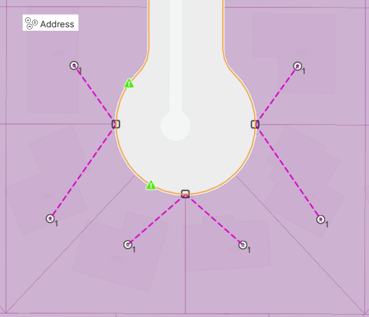
An address is a point that marks a location that needs service, such as a home, a business or an apartment building. Addresses tell FOND where the network needs to reach.
Addresses are used in Fiber Planner, Fiber Design and Power Design projects.
How does FOND use addresses?
| Use | Fiber Planner | Fiber Design | Power Design |
|---|---|---|---|
| The locations the network must serve | ✓ | ✓ | ✓ |
| AddressType sets each address’s fiber allocation through the Demand Model | ✓ | ✓ | — |
| The end point of each leadin | — | ✓ | ✓ |
| Counted as premises for your subscription | ✓ | ✓ | ✓ |
What makes a good address?
- Every location you want to serve has an address, and there are no duplicates. Missing addresses won’t be served, and duplicates are served twice.
- There are no addresses for locations you don’t want to serve. In fiber projects, you can also leave these addresses in and set their AddressType to DNS (do not serve).
- Each address sits on the building it represents, not on the street or the corner of the lot. Where an address sits affects its leadin and the length of its service connection.
- In fiber projects, each address has the right AddressType. The type decides how much fiber the address gets and which tier serves it. An apartment building marked as a single-family home will be under-served.
Get addresses into your project
- Import with Area Select (recommended). FOND’s database includes addresses for the USA and Canada. In fiber projects, each address comes already classified with an AddressType based on its land use. See Import data with Area Select.
- Upload your own. Addresses must be points. For fiber projects, add an AddressType text field that uses the types in your Demand Model. See Input data requirements.
Review your addresses
Review your addresses before you generate leadins or run a plan or design. A missing or misplaced address is quick to fix now, and harder to fix once there’s a network built around it.
Tips for reviewing:
- Use the satellite map to check that addresses sit on buildings, and to spot new developments with no addresses yet. See Moving around the map in FOND.
- Look for duplicates and unwanted locations, such as several addresses stacked on one building, or addresses on vacant land.
- In fiber projects, check AddressTypes, especially for apartment buildings, commercial sites and institutions. Area Select classifications are a good starting point, but they’re worth checking. Use the features table to sort or group addresses by AddressType so unexpected types stand out. See Inspecting a plan or design.
Tip: Finalising the geospatial locations of your addresses helps to avoid utilizing extra premises from your subscription.
Edit addresses
- Choose Input data › Addresses › Draw or Input data > Modify data > Draw.
- Make your changes:
- Add an address by clicking the map where you want it.
- Move an address by selecting it and dragging it.
- Delete addresses by selecting one or more and clicking Delete.
- Save your changes by clicking Finish, or click Cancel to undo every change since you started editing.
Tip: In design projects, be mindful of whether snapping and topological editing are enabled or disabled. If an address already has a leadin, you may want to have topological editing enables so that when you move an address, its leadin moves with it.
Change an address’s type (fiber projects)
In Fiber Planner and Fiber Design projects:
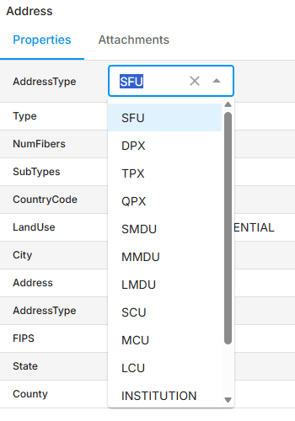
- Click the address on the map, outside of the Draw mode. Its details open in the properties panel.
- Choose a new AddressType from the list.
The Type and NumFibers values update to match the Demand Model. You can’t edit them directly.
Common edits
| Situation | What to do |
|---|---|
| A new development has no addresses because FOND’s data isn’t up to date yet | Add addresses, using satellite imagery as a guide |
| An address sits on the street or a lot corner rather than the building | Move it onto the building |
| An address is a duplicate, or a location you don’t want to serve | Delete it. In fiber projects, you can change its AddressType to DNS instead. |
| Fiber projects: an apartment building or large business has the wrong AddressType | Change its AddressType |